Furniture Mission of the Red River Valley: Giving the Gift of Second Chances

Wednesday, 22 Apr 2026

“Okay, now tell me about your room.”

(Silence)

“What furniture do you have for yourself?”

Still nothing, but volunteer Judy doesn’t give up easily. 

“There isn’t anything you need?”

Finally, a response: “Nope, I’m here for my kids.”

An hour later, Judy has worn her down. The mom of five she’s been helping pick out furniture this afternoon has — begrudgingly — agreed to go home with a few things for herself. 

“By the end of the visit, Judy finally got her to admit that she didn’t have a proper bed,” says Furniture Mission of the Red River Valley Executive Director Jordan McCormick. “And she asked if it would be okay if we could send her home with a bed so that she could take care of herself, too. It comes with the territory of being a parent, to look out for your kids and the people around you. But it can be so tough to ask for help for yourself.”

Since its founding in 2020, Furniture Mission of the Red River Valley has gifted more than 50,000 pieces of furniture to 3,624 families throughout the region.

This type of situation is unfortunately all too common, says McCormick, who was hired to lead the Fargo furniture bank in 2022. 

“While the families we serve are experiencing a variety of circumstances, most of them have one thing in common: They are completely starting over,” he says. “Each one reminds us how easily any of us can find ourselves needing a new beginning. Life can change fast, and in those moments, families find support and stability here. Every bed, table, and couch represents more than furniture. It represents dignity, stability, and a chance for families to rebuild.”

Furniture Mission Cofounder Evert Van Engelenhoven saw this firsthand in 2019 when, as part of a team of Red Cross volunteers, he was dispatched to support a family in South Dakota who had lost everything in a house fire — including a child.

“He came across the Furniture Mission of South Dakota and saw the impact it made for the family,” says McCormick, adding that there has been significant growth in the number of furniture banks throughout the U.S. in recent years. “He saw how much it helped healing and helped them get back on their feet.”

McCormick says that Van Engelenhoven “fell in love” with the concept and knew he had to bring it to Fargo. 

“Evert came back to this community and asked, ‘Who’s doing this?’” McCormick says. “He realized no one was, and so he called some people, established a board, and got to work. His first call was to Darrell Costain, who he’d known forever and was someone who Evert knew to be a doer. Darrell said: ‘Where do I sign?’”

During a recent conversation with a partner agency, a former direct-support professional recalled for Executive Director Jordan McCormick what it was like before Furniture Mission existed: "She said, 'You know, I remember what it was like before Furniture Mission. We had to (use) classified ads, Craig's List, Facebook Marketplace, scratch-and-dent rooms at furniture stores.' She talked about how much time it took to source this furniture. Now, they just call us, and they can spend their time and energy doing other things."

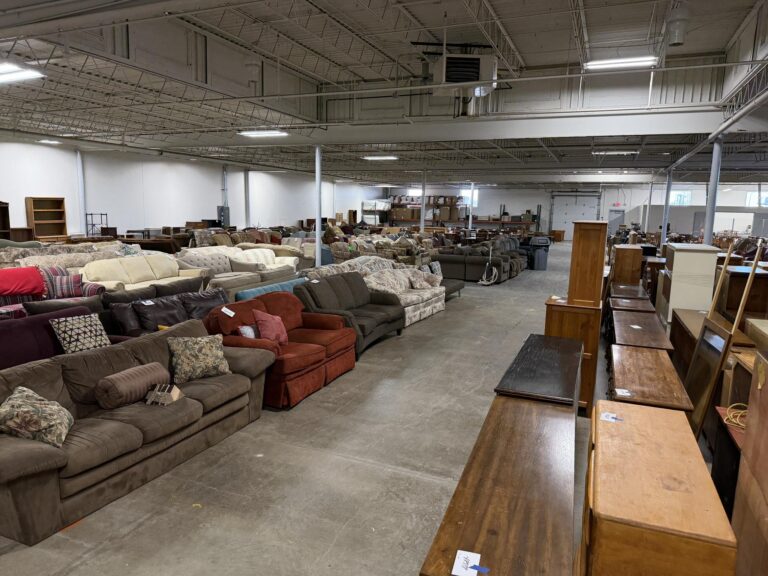
What started with a modest inventory in a donated building has, in just a few short years, blossomed into a 17,000-square-foot warehouse in North Fargo filled with thousands of pieces of furniture, including donated couches, chairs, coffee tables, and lamps, among other items.

“When we first moved into the building, the feeling we all had was: This is a barn,” McCormick recalls. “We were like, ‘We’re never going to fill this. What are we doing?’ And we actually just recently opened an additional 4,000 square feet because we absolutely did fill it. And we continue to fill it and it’s working.”

The people Furniture Mission serves come from a variety of backgrounds and life circumstances, from those coming out of incarceration and addiction treatment to people new to the community to families recovering from a natural disaster. 

And when think of some of the essential items those people need — clean water, food, shelter, medicine — furniture probably doesn’t cross your mind.

“Furniture is something that allows you to live like a human being,” says McCormick. “It allows you to ease the pain of some of those steps of getting back on your feet. It’s a creature comfort. You need things to sit on, to lay on, to socialize. It’s kind of that next thing that allows people to be proud of their space and proud of where they are today. The ability to invite people over, have some fellowship and community in your home because you have a couch, have a table for your kids to do homework at. It’s everything.

“We try to be very upfront that we’re not going to furnish your dream home, but our goal is to get you a couple pieces that you’re so proud about. So you can get a little swagger back and step into this new chapter feeling refreshed with the things that you need in order to do the things that you have to do.”

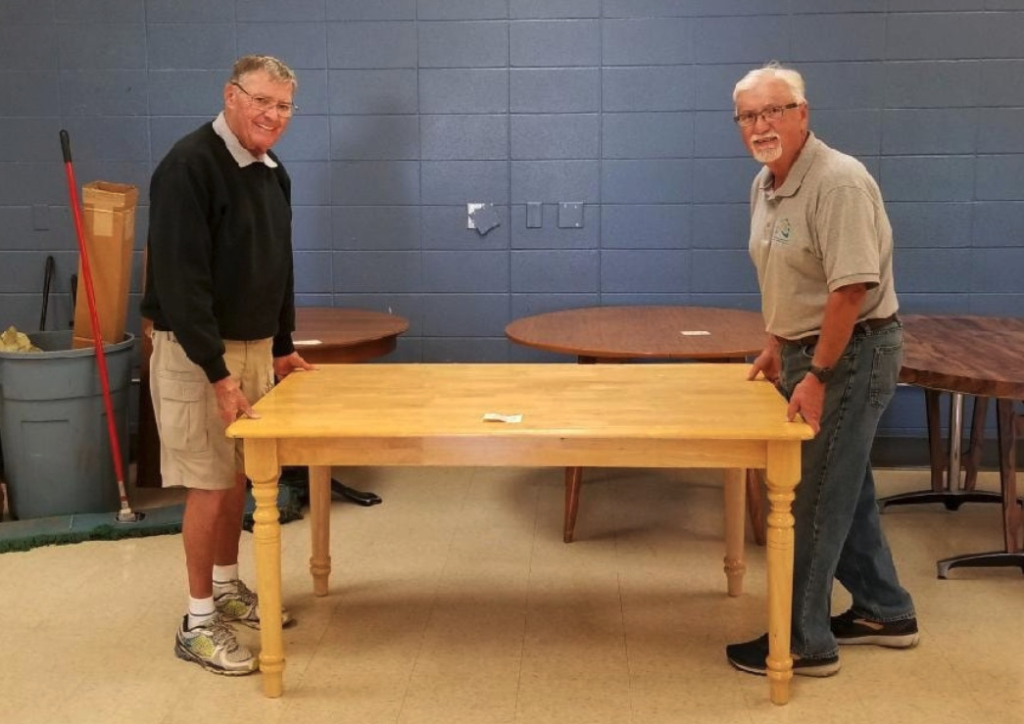
Furniture Mission of the Red River Valley Cofounders Evert Van Engelenhoven (left) and Darrell Costain (right) didn't let the COVID-19 pandemic stop them from getting the organization off the ground in 2020. "I think most people would've taken it as a sign from the universe that: Hey, this isn't the right thing right now," says Executive Director Jordan McCormick. "But they absolutely did not let it stop them."

One of the most eye-opening things for the Furniture Mission team, according to McCormick, has been the representation of kids in their clientele. 

“40 percent of the people we serve are children,” he says. “Which is such a bigger number than we thought it would be. The idea that kids are having better days at school because they’re starting their days waking up in beds is really powerful to us.”

People are typically referred to Furniture Mission via one of its 45-plus local partner organizations, and, when they arrive at the facility, they’re always greeted by a friendly volunteer who helps walk them through the process and encourages them to provide input into the pieces they select.

“We want them to choose the couch and the chair and the sheets and the end table,” McCormick says. “Because we work with people who have not always had a lot of agency, and so there can be a lot of power in some of that choosing.

“Every week, we see people who don’t think they should take something because it’s ‘too nice.’ And we get to say: ‘This isn’t too nice for you. If this couch or this dresser is going to serve you, we want you to have it.’ We want you to know that you’re worthy of having this.”

From church groups to retirees to local fraternities, Furniture Mission relies on a wide variety of volunteers to help serve the hundreds of families that come through its doors each year. In the past year, Executive Director Jordan McCormick estimates that the nonprofit furniture bank hosted approximately 120 total volunteers. Their responsibilities include receiving and managing inventory, accompanying families during the furniture-selection process, and assisting with pick-ups and deliveries.

McCormick says that because the individuals and families that Furniture Mission serves often have a variety of needs, avoiding mission-creep has been an important part of their success.

“We’re asking the question all the time: Is this critical to the thing we’re here to do?” he explains. “And that’s why we don’t have kitchen items or electronics of any kind. Do we have people who call us all the time wanting to give us those things? Absolutely. And our job is to say ‘no’ because we’ve seen that the biggest community need we can solve is furniture. 

“That’s us trying to be intentional about: How do we continue to grow without creeping into other stuff? If it means that we also don’t have to worry about how to manage silverware, that’s a win for us.”

While Furniture Mission ran on the good will of volunteers for the first two years of its existence, they knew that if they were ever going to take it to where they wanted it to go, they needed someone leading the organization on a full-time basis.

“The fact that they’d already operated for two years (without any paid staff) was one of the things that made me so impressed with it,” says McCormick, who was recruited to lead the organization about five years ago. “They had a very active board because they were all volunteers. Everyone took a role. Some people were doing social media and building the website, some people were working in the warehouse, some were driving truck, others were figuring out how we were going to receive referrals from partners or how we were going to manage inventory. 

“By the time I was brought on, it was pretty clear that this was already something very special. The planets had to align just for it to exist. My No. 1 job was to not break it. It wasn’t up to me to make it cool or special because it already is.”

His goal, instead, was to make it more sustainable and establish a foundation from which the organization could scale and serve more people. 

“I found so much joy in being able to learn a lot about everything all at once,” he says. “If somebody needed me to move some furniture or jump in a truck, I could do that. Although, I think it was Evert who was immediately like, ‘No! We have volunteers for that. We want you focused on things that we’re not doing today.’ I thought that was an amazing approach to establishing this position for the next steps of the organization.”

One of those things was fundraising, which McCormick admittedly had little exposure to before he arrived at Furniture Mission. 

“I think I brought a lot to the table,” he says. “I just didn’t have any experience with fundraising. I told (the board) that I could probably get the hang of it after some time, but I’d need a little grace.”

That grace — combined with McCormick being able to devote more of his time to fundraising, learning, and “CEO duties” — has led to some incredible results.

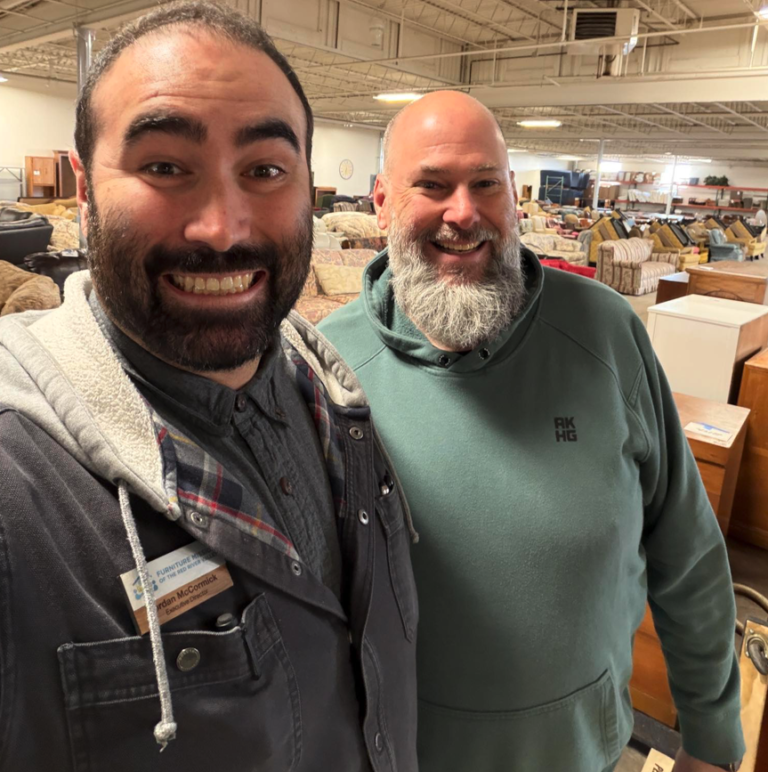
The recent addition of Operations Coordinator Eric Johnson (right) has allowed Executive Director Jordan McCormick (left) to spend more of his time on fundraising, promotion, and cultivating relationships in the community on behalf of Furniture Mission.

“We could have the best mission in the universe, but if we can’t keep the lights on, it’s not going to matter,” says McCormick, who has been a part of Impact Fundraising Coach Erv Inniger’s coaching cohort for multiple years. “Like Erv always says: no money, no mission. So if we want this mission to continue to make the impact that we know our community needs it to make, (fundraising) has to be our biggest priority.

“And so, with the support of the board, I had to let my volunteer teams know: I think you’re going to have to see less of me in the warehouse because I have to do some stuff that’s outside of the warehouse. And so that was kind of the start of the transition to taking development and fundraising and moving to the top of the to-do list instead of ‘Yeah, we’ll get around to it.’”

In addition to recently surpassing more than $1 million of gifted furniture, they’ve also seen impressive growth over the past six years of Giving Hearts Day. What started with $45,080 in 2021 culminated this year with their first appearance in the top five of the Small-Budget category, raising $155,868.

“I think the way we’ve been able to grow our Giving Hearts Days year over year has been a direct result of that work and of focusing on things that are intentionally revenue-focused or revenue-generating,” McCormick says. “You don’t have a great Giving Hearts Day because you start thinking about it in January. Giving Hearts Day is kind of a litmus test for how you’re connecting with the community the rest of the year.”

He also credits the network of fellow charities that Impact trainings and his Giving Hearts Day subscription has provided him access to.

“When I started (at Furniture Mission), we were 2 years old,” he says. “And we felt our age. We were on our feet, but we were not very stable. We knew where we wanted to go, but we just didn’t always know how to get there. We had big visions of what we could be, but we didn’t know how to connect the dots.”

McCormick, who has been a mainstay at Impact and Giving Hearts Day trainings for the past five years, found himself falling into a common trap for young nonprofits.

“It was really hard, in a community where so many nonprofits (seemingly) knew what they were doing. You’re like, ‘Oh man, they’ve got it figured out.’ As it turns out, the grass is always greener. So many of these local leaders — who I now get to call friends — they’re figuring it all out, too. And they’ve been very gracious in making time for me as I ask them a billion questions.”

With the recent warehouse expansion, the onboarding of a second team member, and partnerships that have begun to extend beyond just the Fargo metro, Furniture Mission’s future is bright — an optimism echoed by the organization’s leader. 

“Today, we’re so much more secure in the goal of building something that’s bigger than any one person,” McCormick says. “What we’re trying to do is send every family out of here knowing that: Of all the challenging things they’re going to face, there’s a quirky warehouse in North Fargo full of people who are rooting for them. We know you got this. You’re capable of hard things. We love you. And we’ve got your back.”
About Furniture Mission of the Red River Valley

Furniture Mission of the Red River Valley is a faith-based Fargo furniture bank that provides gently used furniture at no cost to local families and individuals facing crises such as homelessness, domestic violence, and natural disasters. They serve the Fargo metro and surrounding communities through community donations.