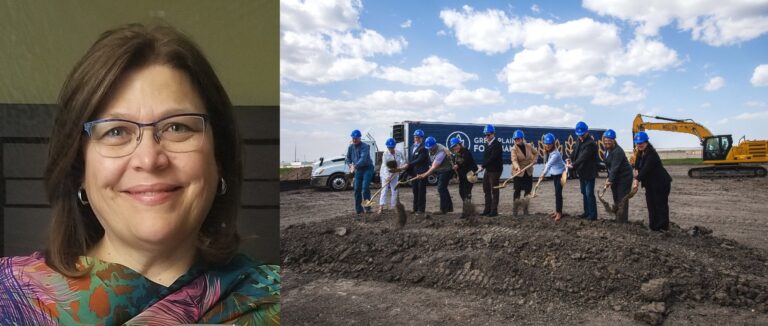
While they’re yet to land their own Discovery Channel series, Marcia Paulson and Darby Njos still think of themselves as MythBusters.
“100 percent (myth-busting) is part of the job,” says Paulson, the chief philanthropy officer at Great Plains Food Bank in Fargo. “Every time the press walks in the door, every service club we get to talk to, every church, every tour, we get to share the reality of who actually comes through our doors. Then, we get to share some data that shows it, in a way that’s respectful and educational.”
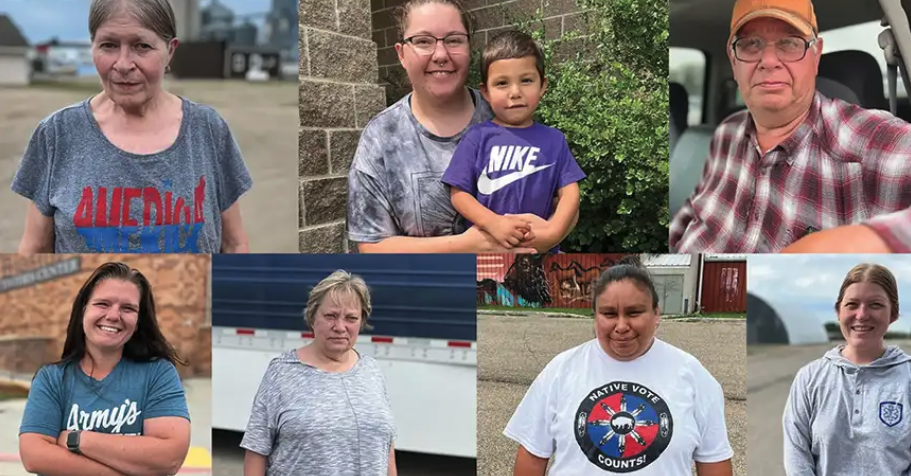
Often rooted in outdated tropes, the “myths” around food-pantry visitors are plenty: chronically homeless, addicts, unemployed fraudsters, system-abusers. The numbers, on the other hand, tell a different story, explains Njos.
“It’s people you wouldn’t think of,” says Njos, who works in communications and marketing at Great Plains Food Bank. “And it’s a wide variety. It’s people who had an unexpected expense or their car broke down, and so they’ve turned to a food pantry because they just needed it this one time. Or it’s people who have had chronic illnesses, and so they can’t afford their medication and groceries.”
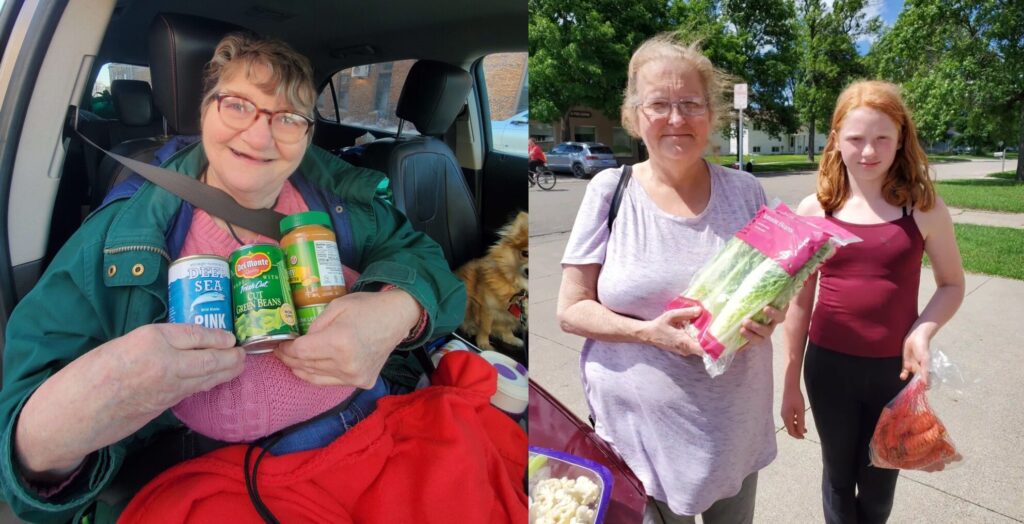
Of the 167,163 people served last year by Great Plains Food Bank — the most ever in the food bank’s 44-year history — 36 percent were kids and 15 percent were seniors. That’s more than half.
“That’s another thing we’ve seen a lot more of lately is more and more seniors taking on full-time caregiving for their grandkids,” Paulson says. “For whatever reason, the parents are in and out of the picture, and grandparents are becoming guardians of or primary caregivers of their grandchildren.
“Social Security checks don’t increase when you have little mouths or teenage mouths to feed, and so people who have worked all their lives — who are in retirement — lean in and continue to be parents to these kids. But that forces them to say: ‘Now where do I go?’ They need a place to turn.”
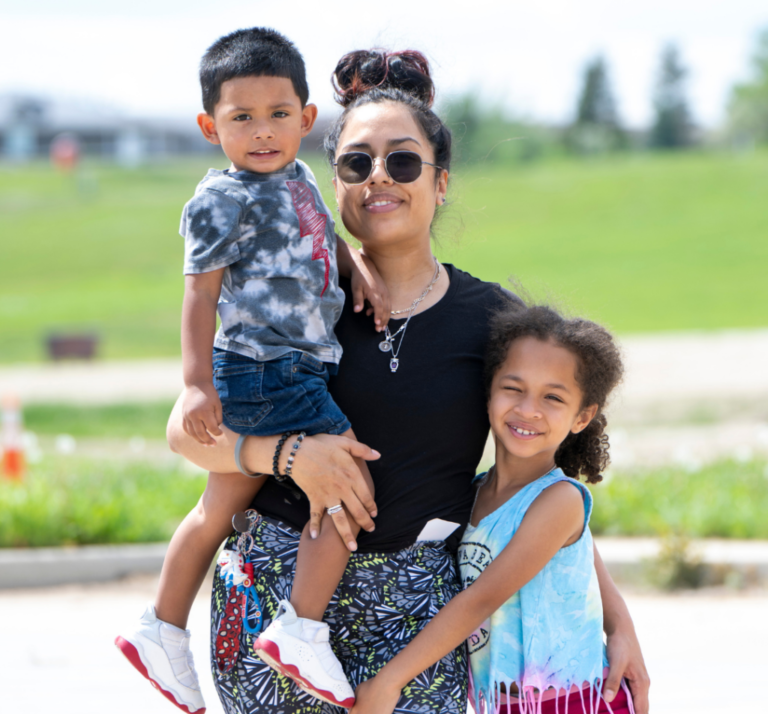
There are also folks like Francis, who, due to the rising cost of childcare, stays home full-time with her two young kids while her husband works full-time for the county. Living on a single income has its challenges, Francis says, especially during the summer months when school meals aren’t available.
“It’s a lot harder,” Francis says. “It’s more food intake, and it’s a really big dip in our wallet.”
Following in the footsteps of St. Mary’s Food Bank in Arizona, which pioneered the food bank model for the rest of the world, Great Plains Food Bank was founded in 1983 as the Greater Fargo-Moorhead Food Bank. Following a rebrand and expansion of its geographic footprint, the food bank adopted the hub-and-spoke model employed by St. Mary’s where a large, centralized food bank functions as the “hub,” with smaller, local pantries and shelters serving as “spokes.”
“We source and distribute surplus food from those who have it to those who need it,” Paulson explains. “And the source of food is our food industry and the place of distribution is the food-pantry network. And so our role is unique, but we work in partnership with the pantry network, each playing a very critical role in the chain.”
That chain, which is made up of more than 200 pantries, shelters, meal sites, and other charitable feeding programs throughout North Dakota and Clay County, Minnesota, is almost entirely dependent on the Great Plains Food Bank. With 93 percent of all food moving through the regional charitable network being sourced or facilitated by Great Plains, any gaps in or disruptions to that sourcing — like the ones they’ve seen the past couple years — are felt far and wide.
“Not really until the past seven or eight years have we had to purchase (food) to fill the gap,” explains Paulson, adding that when she started at the food bank more than two decades ago, 100 percent of the food they distributed was donated. “And that purchasing slice just keeps getting bigger and bigger. I think we’re at about 15 percent right now. That’s a $3.5 million price tag. We can’t sustain that.”
Changes in public sector funding have posed a challenge as well, Paulson explains, with cuts to the Local Food Purchase Assistance program (LFPA) and The Emergency Food Assistance Program (TEFAP) creating uncertainty around how they’re going to keep up with the growing need.
“As more and more people need us, the pounds available — at least from the federal government sector — that shelf-stable product is going away,” Paulson says. “And so that challenges us to find more resources in other areas, which is a good thing because there’s more food in North Dakota than we know what to do with. Allowing us to lean into the producers and growers in our state, as well as the retailers, has been where we’ve made up ground with the lack of government resources.”
Another way Great Plains Food Bank has made up for a decrease in public dollars is by making the most out of Giving Hearts Day each February.
In 2026, they surpassed the $1-million mark for the first time in their 15 years of participation, which Paulson says is a testament to the approach the organization takes to the giving day. And while Giving Hearts Day only accounts for about 11 percent of Great Plains Food Bank’s private budget — considerably less than a lot of other regional organizations — that doesn’t mean they take it any less seriously.
“It’s year-round, department-wide,” she says. “And in some cases, organization-wide. We’re just moving through our budget cycle right now, and Giving Hearts Day has its own line. And everyone’s built their strategy around it to say: This is our goal.
“We’re talking about it now, even before we start the new fiscal year on July 1. We’re (building) a calendar for February, and our major-gifts team has already been thinking about match partners when they’re putting their portfolios together.”
For Njos, GHD also functions as an enthusiasm-generator for people who may not be familiar with Great Plains Food Bank’s mission.
“Giving Hearts Day is a great way for us to continue to involve new people,” she says. “It gives us a platform to extend that invitation and invite others in such an easy way, whether they donate, get involved (through volunteering), or give goods. It creates a broader conversation about getting involved.”
In addition to the special emphasis they’ve placed on match dollars and focusing their GHD campaign on a specific program, FEED KIDS, Paulson points to something else to explain their steep upward trajectory that started about six years ago.
“Direct mail,” she says. “We started mailing to every donor on our file across North Dakota. We have a very aggressive direct-mail program, and it works because we also have a very targeted digital online program. They go hand-in-hand.”
“We’ve found that people have shifted their giving out of (year-end giving) in November and December into February because they want to be part of Giving Hearts Day. Now, many just give a second gift, which tells us that our state is saying, for hunger relief, ‘This is important.’”
As Great Plains Food Bank continues to grow support for its mission, new possibilities emerge. The ones that excite Paulson the most are investments that could help the organization better control its own destiny and rely less on political and economic tides.
“Investing in food and food partnerships beyond the traditional,” she says. “And being as innovative as possible. Maybe it’s a mobile grocery store, maybe we have acres that we buy into and we become (the farmers). Maybe it’s value-added processing, where we work with the durum growers and the manufacturers to create semi-loads of pasta.
“How do we go beyond food donations into food sourcing and supply channels? I’ve heard about drone drops of food into food deserts. There are so many ways in which to get food closer to people.”
For Great Plains Food Bank to achieve its three bold goals — ending hunger today, tomorrow, and for good — they know that one of the most effective strategies is to focus on the things that lead to food insecurity in the first place.
“I lean toward the social determinants of health,” Paulson says. “Certainly, poverty is an underlying thread. If you don’t have enough money to get enough food, you are food insecure. And then you think about the layer upon layer impacting not just a paycheck but also chronic medical conditions, isolation, the ruralness of North Dakota, transportation challenges — one in three people don’t have transportation to even get to work or get their kids to school. Then, you start adding in language barriers, different abilities, pride, all of that.”
For Paulson, the solutions necessarily extend beyond just making sure people’s cupboards are full.
“We have to put money in the prevention side of things,” she says. “And to me, some of that is system work. It’s legislative work, advocacy work, (social) safety net, encouragement programs for workforce development. We have to work upstream as much as we’re working downstream.”
About Great Plains Food Bank
Now in its 43rd year, the Great Plains Food Bank serves as North Dakota’s only food bank. Its partner network includes 205 food pantries, shelters, meal sites, and other charitable feeding programs operating in 104 communities across North Dakota and Clay County, Minnesota. Since 1983, the Great Plains Food Bank, through its array of innovative direct-service programs and partner network, have distributed more than 256 million meals to children, seniors, and families in need. The Great Plains Food Bank is a partner food bank of Feeding America, the nation’s food bank network.